
Career Pathways and Qualification Levels

In England, the law says that young people must stay in education or training until the age of 18. This does not mean they must stay in school — but they must continue learning in one of several approved ways.

There are several different options after 16. These can include:

  • Full-time education – e.g. Sixth Form, College, or a training provider.
  • Apprenticeship or Traineeship – combining work with training and study.

At 18-year-old, students can leave education and there are a range of different options available.


Click on the expanders to see more information about the different options available:

We support all our students in Year 11 with quality, impartial career guidance as to their next steps after school, whether it is at Hendon School, another Sixth Form, Further Education at a College, other Training Providers, or an Apprenticeships. All Year 11 students will have a careers appointment with our own inhouse Career Advisor, Mrs Mohammad who is a Level 6 qualified and a member of the Career Development Institute (CDI). Students can also drop in at break and lunchtime for advice without an appointment.


Post 16 options

There are several options available to students at the end of Year 11. The table below provides an overview of the main options.

What can I do at the end of Year 11?


Sixth Form College Apprenticeship Alternatives
What? What? What? What?

Staying at school sixth form / sixth form college after Year 11 to study A-Levels and/or other Level 3 vocational qualifications for 2 years

Some Sixth Forms will also offer some Level 2 courses

You can apply to study "vocational" subjects e.g. Engineering, Motor Mechanics and Construction.

Colleges also offer A-Levels

Courses are available from Entry level to Level 3

A fulltime job with training. You learn work-based skills on the job and will normally attend college or a training provider for 1 day per week. 

Apprenticeships are available in all job sectors.

For students for whom school / college or apprenticeships are not suitable options, there are other specialist providers. 
Where?  Where?  Where? Where?
Hendon School, other local schools or Woodhouse Sixth Form

 Barnet and Southgate College

Capital City College

Harrow College

There are lots of employers who provide these opportunities including:

www.Firstrung.org.uk

www.gov.uk/apply-apprenticeship


What Grades do I need? What Grades do I need? What Grades do I need? What Grades do I need?

At least 5 GCSE's at grade 9-5 including English and Maths. 

Most schools/colleges will ask for higher grades.

Entry level - no specific grades

Level 1 - normally 3 subjects at Grade 2 or above

Level 2 - normally 3 subjects as Grade 3 or above

Level 3 - normally 5 subjects at Grade 4 or above including English and Maths

This can vary depending on what Level apprenticeship you are applying for. 

Competition is fierce, you will need to be dedicated and motivated to get through the process.

No specific grades for some of these courses. It is about developing basic and functional skills. 
How to find out more? How to find out more? How to find out more? How to find out more?

Unifrog - Careers platform

Sixth Form / College open Evenings

Unifrog - Careers platform

Attend College open days

Look on College websites

Unifrog - Careers platform

www.higherin.com

Book an appointment with our Careers Advisor

Book an appointment with our Careers Advisor
Dont forget - you are required to remain in education or employment with training until your 18th Birthday!

At the end of Year 11 students can chose to stay at Hendon School or apply to other local schools or sixth-form colleges.

In order to support students, you will be issued with a list of local schools and college open days. It is really important that you visit other schools/colleges to find out what subjects they are offering and their entry requirements.

Each October all Year 11 students are given a copy of local school, college and training providers open days. These are also uploaded onto the school intranet.

From the age of 16, young people can apply for an apprenticeship, which is a paid job that combines workplace experience with structured training. Apprentices spend most of their time with an employer, learning practical skills on the job, while also studying (usually one day a week) towards a nationally recognised qualification.

Apprenticeships are available across a wide range of sectors — from construction, engineering, and health care to IT, business, and the creative industries. They start at Level 2 (Intermediate) and can progress through Level 3 (Advanced) and beyond, leading all the way to Higher and Degree Apprenticeships. This means your child can continue to learn and gain qualifications without needing to follow a purely academic route.

Apprentices receive at least the apprenticeship minimum wage (often higher, depending on the employer) and have the same employment rights as other staff, including paid holidays. They are supported by both their employer and a training provider to ensure they develop the skills and knowledge required for their chosen career.

For many young people, an apprenticeship offers an excellent alternative to sixth form or college, allowing them to gain qualifications, experience, and financial independence at the same time.


Websites that can support and advertise opportunities:

General information about apprenticeships: https://www.amazingapprenticeships.com/

Government website with opportunities: www.findapprenticeship.service.gov.uk/apprenticeshipsearch

Another site advertising apprenticeship opportunities: https://higherin.com/

First Rung  - local Barnet provider of apprenticeships https://www.firstrung.org.uk/


Each year we take part in National Apprenticeship Week (2nd week of February). The website contains lots of information to help Parents/Carers and students www.nationalapprenticeshipweek.co.uk

Supported Internships

Supported Internships are structured  work-based study programmes for young people aged 16–24 with an Education, Health and Care Plan (EHCP) to help support them into paid employment. They are designed to help students develop the skills, confidence, and experience needed for work.

Internships are usually 5 days  a week last 10 months. Interns spend around 70% of their time with an employer, supported by a job coach, alongside classroom-based learning including English, maths, and employability skills. Internships are unpaid. The goal is to prepare young people for long-term, sustainable employment.

Open days are held between January and April each year. Applications usually involve an interview and some task-based activities.

Students interested in this pathway will be supported by our SEND department and our Careers Advisor.


Traineeships

Traineeships are short courses (from 6 weeks up to 1 year) for young people aged 16–24 who need extra help before moving into an apprenticeship, further study, or work. They include work preparation training, English and maths (if required), and a work placement to build confidence and employability skills. Traineeships are unpaid but give valuable experience to support the next step into an apprenticeship or job.

Students interested in this pathway will be supported by relevant staff and our Careers Advisor.

Post 18 Options

Further Education (FE) colleges provide education and training for students aged 16 and over. Colleges will usually offer a wider range of courses including academic, vocational, and technical courses.

FE colleges are designed to support different learning styles and career ambitions. Some students use them as a stepping stone to university, while others gain practical skills to move directly into the workplace. Many colleges also offer specialist facilities and industry links, giving students valuable hands-on work experience.

FE colleges can be an excellent option for young people who prefer practical learning, want a broader range of subjects, or are keen to explore a specific career pathway.

For those over 18 years old some FE colleges offer degree-level qualifications. These include Foundation Degrees, Higher National Certificates (HNCs), Higher National Diplomas (HNDs). This means students can progress from vocational or technical qualifications to university-level study within an FE college. So, while FE colleges are not universities, they do offer degree-level study in selected subjects – often with smaller class sizes, lower costs, and strong links to local employers.

Local FE colleges include Barnet and Southgate, Harrow and Capital City College Group.

University is a significant step where students typically spend three to four years studying a subject, leading to a Bachelor’s degree.

Current tuition fees for home students are £9,535 per year. Students currently can apply for a student loan to pay for their tuition, which they begin repaying only after earning above a threshold (currently £25,000 annually) https://www.gov.uk/government/organisations/student-loans-company

Maintenance loans (for day-to-day expenses) are available for some students who are from low-income families. https://www.gov.uk/student-finance/new-fulltime-students

A university degree remains the most recognised route into careers such as medicine, law, engineering, and teaching. It can also open doors to postgraduate study (e.g., Master’s or PhD), internships, and graduate-level employment. D typically offer strong long-term earning potential and opportunities.

All applications to university go through UCAS www.ucas.com

Students can apply for an apprenticeship, which is a paid job that combines workplace experience with structured training. Apprentices spend most of their time with an employer, learning practical skills on the job, while also studying (usually one day a week) towards a nationally recognised qualification.

Apprenticeships are available across a wide range of sectors — from construction, engineering, and health care to IT, business, and the creative industries. There are Higher and Degree level Apprenticeships available, but these can be very competitive.


Websites that can support and advertise opportunities:

General information about apprenticeships: https: www.amazingapprenticeships.com/  

Government website with opportunities: www.findapprenticeship.service.gov.uk/apprenticeshipsearch

Other sites advertising apprenticeship opportunities: www.higherin.com

www.ucas.co.uk ; www.pathwayctm.com and www.dartmouthpartners.com/foundation


Each year we take part in National Apprenticeship Week (2nd week of February). The website contains lots of information to help Parents/Carers and students www.nationalapprenticeshipweek.co.uk

A gap year is when a young person takes time out (usually a year) after finishing school or college before starting university, an apprenticeship, or full-time work. Students may use this time to work, travel, volunteer, or gain new skills and experiences.

A well-planned gap year can help young people build independence, confidence, and employability skills. It may also give them valuable work experience or a clearer sense of their future direction.

Parents should encourage their child to plan carefully, as a gap year can be enriching, but without structure it risks becoming unproductive.

There are several sites that can support students considering a gap year.

www.gap-year.com

www.gapforce.org/gb

An EDT placement will give students an opportunity to continue their STEM journey after leaving school or college and take a paid gap year to help inform and shape their future career choices.

www.etrust.org.uk/programmes-platinum-placements

For some young people, moving directly into full-time employment at 18 is the right choice. Employment offers the young person a chance to earn a salary and develop workplace skills straight away. Many employers also provide opportunities for training and professional development, allowing young people to continue learning while working.

It is important to support young people in finding jobs that offer genuine prospects, fair pay, and opportunities for growth, rather than short-term or casual roles that may limit progression.

Qualification levels 

In the UK, education and career progression are described using qualification levels. Year 11 students complete their GCSE or vocational qualifications at level 2. If they pass at grades 9-4, they have a level 2 pass. If they achieve a grade 1-3 this is a level 1 pass.

Students can then work through the different qualification levels or move to employment at 18 years old.
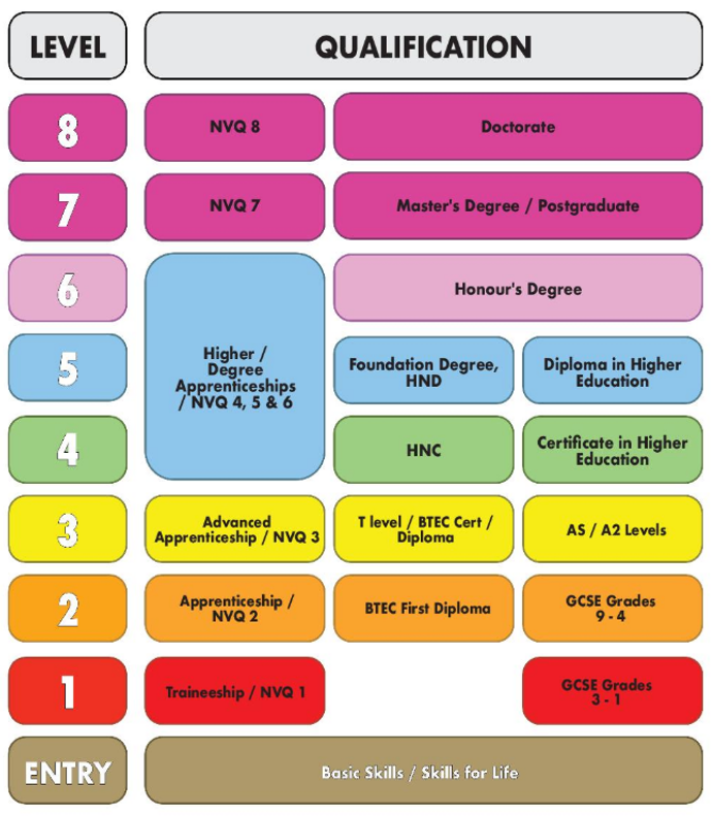
 

Qualifications and Training glossary 

Key Term

Definition

Level

Example

Apprenticeship A paid job with training, combining work and study. Usually, one day a week is spent learning. Levels 2–7 Intermediate Apprenticeship (Level 2), Degree Apprenticeship (Level 6)
BTEC Vocational qualification focusing on practical skills and coursework in specific subjects. Levels 1–7 BTEC National Diploma in Health and Social Care (Level 3)
Entry Level The starting point of the qualification framework; builds basic skills before progressing higher. Below Level 1 Entry Level Certificate in Maths or English
Foundation Degree 2 years that combine study with work. It can be topped up later to a full degree Level 5 Foundation Degree in Early Years
HNC One-year higher education qualification; vocational and industry-focused. Level 4 HNC in Business
HND Two-year qualification, more advanced than HNC; equivalent to the second year of a degree. Level 5 HND in Engineering
NVQ Work-based qualification assessing practical skills and knowledge. Levels 1–7 NVQ Level 3 in Customer Service
T Level Two-year qualification equivalent to 3 A Levels, combining study with industry placement. Level 3 T Level in Digital Production, Design and Development
Traineeship Short course (6 weeks–6 months) to prepare young people for apprenticeships or work. Entry Level up to Level 3 Traineeship with work placement in retail
